The short version
Get rid of squirrels by removing them with a one-way exclusion door (timed for any litter), sealing the entry, and trimming the branches and securing the feeders. Their constant gnawing makes the wiring a fire risk, so act fast.
- Get rid of squirrels with three jobs: remove, exclude, remove the route.
- The one-way door is the humane method.
- Seal gaps over 1.5 inches and trim the branches.
- A litter changes the timing.
For homeowners and property managers with an active squirrel problem who want a plan, not a sales pitch.
What to look for
If you remove one but leave the gap and the branch, the next squirrel moves in. Squirrels den in attics and walls, entering through gaps as small as 1.5 inches, and they gnaw constantly. The fix is remove, exclude, and remove the route — in that order.
- 1Scratching, scurrying, and darting overhead at dawn and dusk — squirrels are daytime animals.
- 2Chewed wood, gnawed wiring, and shredded insulation in the attic.
- 3A gap as small as 1.5 inches in the roofline or soffit.
- 4A squirrel running along power lines or leaping from a tree to the roof.
- 5Nesting material — leaves, twigs, and shredded insulation — in an attic or wall.
- 6Morning and evening noise, when squirrels are most active.
Why it’s worth acting soon
- Squirrels gnaw constantly — chewed wiring is a fire risk.
- A denning squirrel shreds insulation and can damage the structure.
- Squirrels rarely carry rabies, but a cornered one will bite, and fleas and mites come with them.
- An open entry means the next squirrel moves in after the first is removed.
$250–$500Typical squirrel removal (published range)Fixr Treatment options and typical costs
Inspection and entry mapping
$100–$250
A provider finds every gap a squirrel could use and confirms whether one is denning now.
- Time
- 45–90 minutes
- Best for
- Any sighting or daytime noise.
Removal with a one-way door
$250–$500
A one-way exclusion door lets the squirrel leave but not return, then the entry is sealed. Handles a litter too.
- Time
- 1–3 days
- Best for
- A squirrel denning in an attic or wall now.
Exclusion and repair
$300–$1,000+
Sealing every gap larger than 1.5 inches and repairing the gnawed wood.
- Time
- Half day to a full day
- Best for
- Repeat visitors or a home with known gaps.
Cleanup and insulation replacement
$300–$1,000+
Removing nesting material and droppings, and replacing soiled or shredded insulation.
- Time
- Half day to a day
- Best for
- An attic with nesting or droppings.
Prices are typical published ranges. Ask what’s included before you compare quotes.
 Inside, look for nests, droppings and flattened or soiled insulation.
Remove the squirrel, humanely.
Hire a provider to install a one-way exclusion door — the squirrel leaves on its own and can't return. In spring or late summer, they'll time it so a litter isn't left behind.
Seal the entry.
Once it's out, seal every gap larger than 1.5 inches, screen the vents, and cap the chimney. This is the part that keeps the next squirrel out.
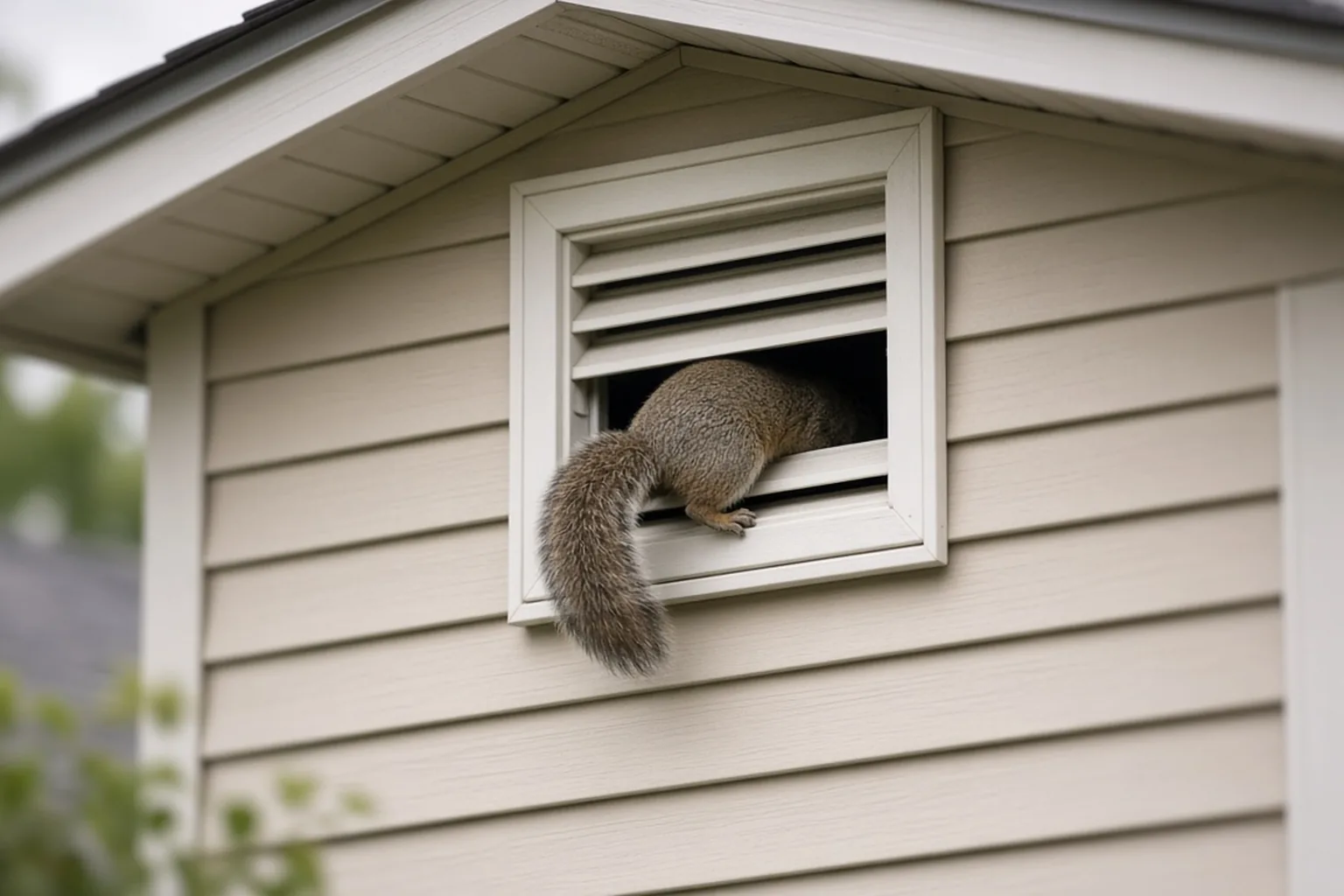 Gable vents without sturdy mesh are easy entry points.
Remove the route and food.
Trim branches 6 to 8 feet back, and move or secure bird feeders. A squirrel that can't reach the roof or eat near the house has no reason to den there.
When to call.
Call when a squirrel is denning inside, when you hear it in a wall, or when gnawed wiring points to a fire risk. The removal, the litter handling, and the wiring are all professional jobs.
The order matters.
Doing it out of order — sealing before removing, or skipping the cleanup — is how a small job becomes a big one. Remove, then exclude, then clean. Install the one-way door, let the squirrel leave, seal the entry, then clean the nest.
The litter complication.
Sealing the mother out from her young is a mess and a cruelty. In spring and late summer, check for kits before and during removal. A one-way door timed so the whole family leaves together is the humane answer.
The route and food.
The branch and the feeder are the part of the job that lasts. Squirrels come for shelter and food. Even after removal and sealing, an overhanging branch and a bird feeder keep drawing new squirrels.
The seasonal cadence.
Squirrels breed in late winter/spring and late summer/fall, so the prevention rhythm is a roofline check before each breeding season. Two well-timed passes beat a season of reactions.
What affects the price
- Whether squirrels are denning in the attic versus just passing through the yard.
- The number and location of entry points that need sealing.
- Whether a litter is present in a wall or attic.
- Whether gnawed wiring or insulation needs repair.
- The amount of cleanup and insulation replacement needed.
- Emergency or same-day calls.
📊
What is your biggest concern about squirrels in your home?
When to call for help
Call a professional when a squirrel is denning in the attic or walls, when you hear it in a wall void, or when gnawed wiring points to a fire risk. A one-way door handles the removal humanely, and a provider will check for a litter so none are left behind.
What you can do yourself
What isn't yours is the squirrel itself — the one-way door needs timing so no litter is left behind, and a cornered squirrel will bite. Leave the removal to a professional. Prevention is safely yours: seal the gaps, trim the branches, and secure the feeders.
Where you live matters
In How To Get Rid Of Squirrels, most problems do not disappear after a single visit if the conditions that caused them are still present, so the plan should spell out what changes afterward and how you will know it worked. In How To Get Rid Of Squirrels, after treatment, ask what to watch for and when a follow-up visit would make sense. In How To Get Rid Of Squirrels, if you have photos or a rough timeline of when the problem started, share them, because those details help the provider confirm what is going on and give you a more accurate scope and price. In How To Get Rid Of Squirrels, a little preparation usually makes the visit more useful: clear access to the areas where you have seen activity, put away loose items, and note anything you have noticed recently. In How To Get Rid Of Squirrels, getting the scope, the prep steps, and any follow-up terms in writing makes it much easier to compare providers fairly, and a good provider will walk you through each of these without pressure. In How To Get Rid Of Squirrels, before you book, ask whether the inspection is included, what the treatment plan covers, how many visits to expect, and what the written quote includes. A local provider who knows How To Get Rid Of Squirrels can point out the specific things that matter most here before you commit to a plan. In How To Get Rid Of Squirrels, checking the usual entry points, moisture spots, and sheltered areas near the structure usually turns up the conditions that are letting them in. The most useful first step in How To Get Rid Of Squirrels is to note where you have seen squirrels activity and when it appears, so an inspection is faster and the quote more accurate. Removal is usually done with a one-way exclusion door, and their constant gnawing makes attic wiring a fire risk. Squirrels are found nationwide and are daytime animals that den in attics. In How To Get Rid Of Squirrels, droppings and urine build up under a long-standing roost, and cleaning them disturbs dust that can carry spores, so cleanup should be done with the right protection and often as a separate scope from the exclusion work itself. In How To Get Rid Of Squirrels, it has to be timed outside the maternity season so young bats are not stranded inside, which is why it is usually a professional job rather than a do-it-yourself one. In How To Get Rid Of Squirrels, exclusion is the durable fix: one-way devices let the bats leave but not return, and then every remaining gap is sealed. In How To Get Rid Of Squirrels, a bat found in a room where someone was sleeping, or one that may have touched a child or pet, is treated as a possible exposure, so contact public health or a doctor before releasing it. In How To Get Rid Of Squirrels, if you have seen a bat indoors, keep the room closed and do not handle it bare-handed. In How To Get Rid Of Squirrels, a short watch at dusk is often the clearest way to confirm where they are getting in and out. In How To Get Rid Of Squirrels, bats squeeze through gaps as small as three-eighths of an inch, so an inspection looks closely at ridge vents, gable vents, soffits, and the joints where the roof meets the wall. Most bat work is about the roofline and the attic. In How To Get Rid Of Squirrels, that usually means sealing the gaps and moisture issues the inspection turned up, adjusting what is stored near the structure, and staying on top of the small warning signs before they become a bigger job. Prevention is the part that keeps the problem from coming back.
Simple ways to keep squirrels away
- Seal every gap larger than 1.5 inches in the roofline, soffits, and vents.
- Cap the chimney and screen vents and soffits with sturdy mesh.
- Trim tree branches back at least 6 to 8 feet from the roof.
- Keep bird feeders away from the house or switch to squirrel-resistant ones.
- Repair loose or damaged roofline trim before squirrels widen it.
- Check the roofline each late winter and late summer, before the breeding seasons.
 Seal gaps with metal mesh or flashing. Squirrels chew straight through foam.
Did you know?
Squirrels can rotate their ankles 180 degrees, letting them climb down trees headfirst.
A squirrel's front teeth never stop growing, which is why it gnaws constantly.
Squirrels use elaborate fake-burying tactics to fool other animals trying to steal their food.
Questions people ask
How do I get rid of squirrels for good?
Remove them with a one-way door, seal the entry, and remove the branch and feeder. There's no one-and-done — it's the three jobs together that work.
Can I get rid of squirrels without killing them?
Yes — the one-way exclusion door is the humane standard. The squirrel leaves on its own.
How long does squirrel removal take?
A few days to a couple of weeks when a litter is involved: inspection, the one-way door, confirming the exit, then sealing and cleanup.
Will they come back?
They can, if the entry stays open and the branch is still there. Sealing the gap and trimming the branch is what makes removal stick.
Sources (4)
The facts in this article come from the public sources listed above. Every home is different, so ask the company you talk to about pricing and what’s included. Published by Squirrel Exterminator · Updated October 13, 2026 · How we write these guides